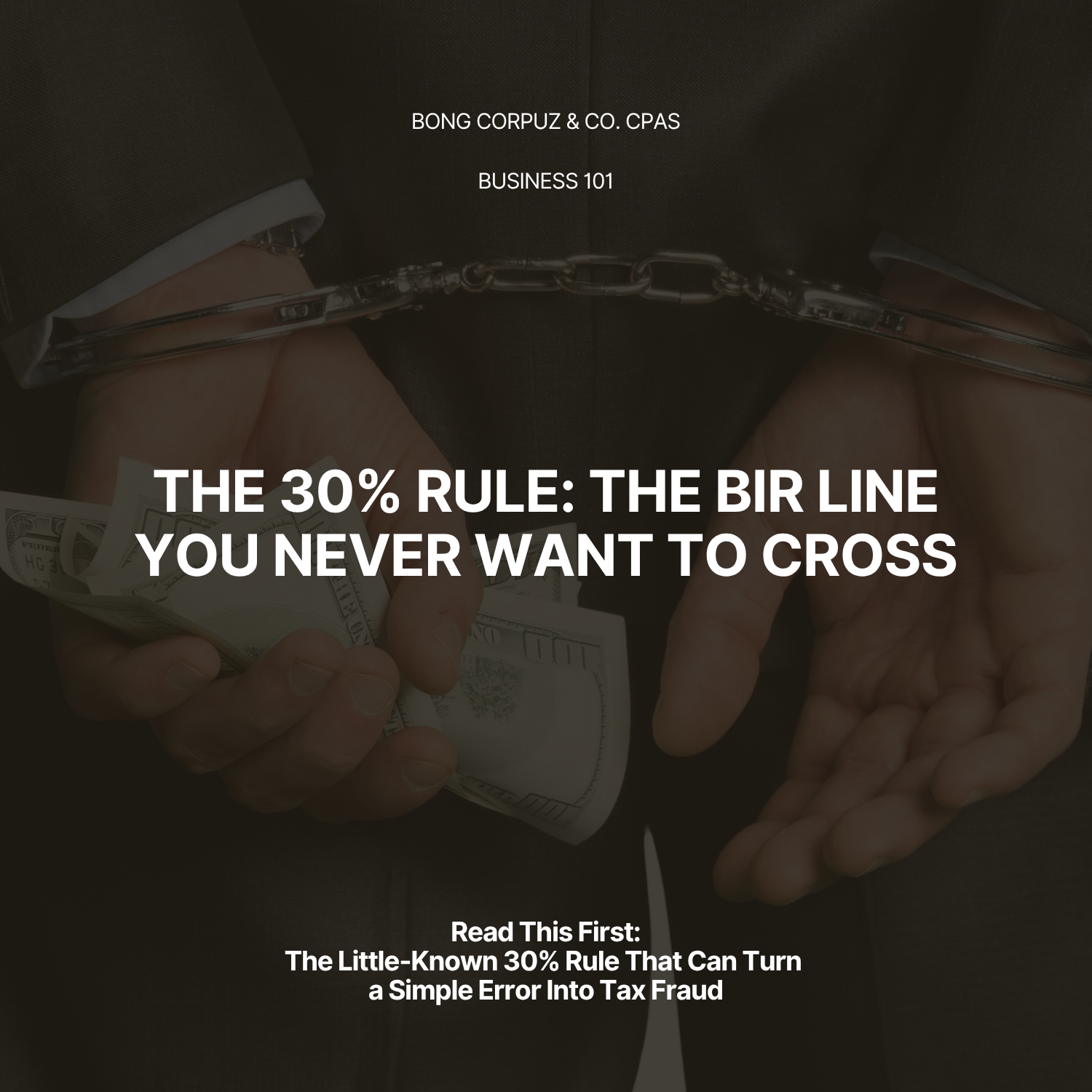
Think a small “adjustment” on your tax return won’t hurt? Think again.
Every year, countless business owners unknowingly cross a silent red line in the Tax Code, a line that can instantly turn an ordinary tax return intoprima facie evidence of fraud.
Meet the30% Rule.
If youunder-declare your income or sales by more than 30%, oroverstate your expenses by more than 30%, the Bureau of Internal Revenue (BIR) can legally treat your tax return asfalse or fraudulent.
This isn’t a rumor or BIR “policy memo.”
It’s written directly into Section 248(B) of the National Internal Revenue Code (NIRC), and reaffirmed by Revenue Regulations (RR) No. 6-2024, issued in March 2024.
What Exactly Does the 30% Rule Mean?
Here’s how it works, straight from the law:
“A substantial under declaration of taxable sales, receipts or income, or a substantial overstatement of deductions, defined as more than 30% of that declared per return, shall constitute prima facie evidence of a false or fraudulent return.”(Section 248[B], NIRC)
So if your tax return says one thing but your books say another, by more than 30%, that alone can trigger a fraud investigation.
| Example | Declared | Actual | Difference | Effect |
|---|---|---|---|---|
| Income | ₱1,000,000 | ₱1,400,000 | +40% | Fraud indicator |
| Expenses | ₱1,000,000 | ₱700,000 | −30%+ | Fraud indicator |
That 30% gap isn’t a cushion, it’s a cliff edge. Once you fall past it, the BIR has every right to dig deeper.
The Real Cost of a Fraudulent Return
Once a return is proven false or fraudulent, the penalties under theTax Code (Sections 248 & 249)are far from minor:
➡50% surchargeon the basic tax due
➡12% annual interest(as per RR No. 6-2024)
➡Criminal penalties (Sec. 257):
• Fine of up to twice the tax due
• Imprisonment of 2–10 years, depending on the case
And there’s no upper limit, the bigger the undeclared amount, the bigger the financial and legal fallout.
Micro and Small Taxpayers:
Reduced Penalties, Not Exempt
RR No. 6-2024 was designed to ease compliance forMicro and Small Taxpayers (MSTs):
- Interest rate reduced from20% to 12% per annum
- Surcharge for late filing cut from50% to 10%
But here’s the catch,these reductions don’t cover fraud.
The 30% Rule remains fully enforceable. Once the BIR proves intent to evade taxes, you face thestandard penalties, regardless of business size.
Legal References
- Section 248, NIRC– Civil penalties for false or fraudulent returns
- Section 249, NIRC– Interest on unpaid taxes
- Section 257, NIRC– Criminal penalties for tax evasion
- Revenue Regulations No. 6-2024– Updated penalty structure for Micro and Small Taxpayers
Bottom Line
The30% Ruleisn’t a “gray area”, it’s the thin line separating honest mistakes from criminal fraud.
Even small businesses are accountable.
Keep your books clean, declare truthfully, and never “pad” deductions just to save a little tax.
Because once that 30% threshold is crossed, it’s not just a discrepancy, it’s ared flag.
Got questions about your taxes?
Let Bong Corpuz & Co. CPAs help you keep things simple, transparent, and stress-free.
